
From Diamonds to Rolls: Exploring the Shapes of Baklava

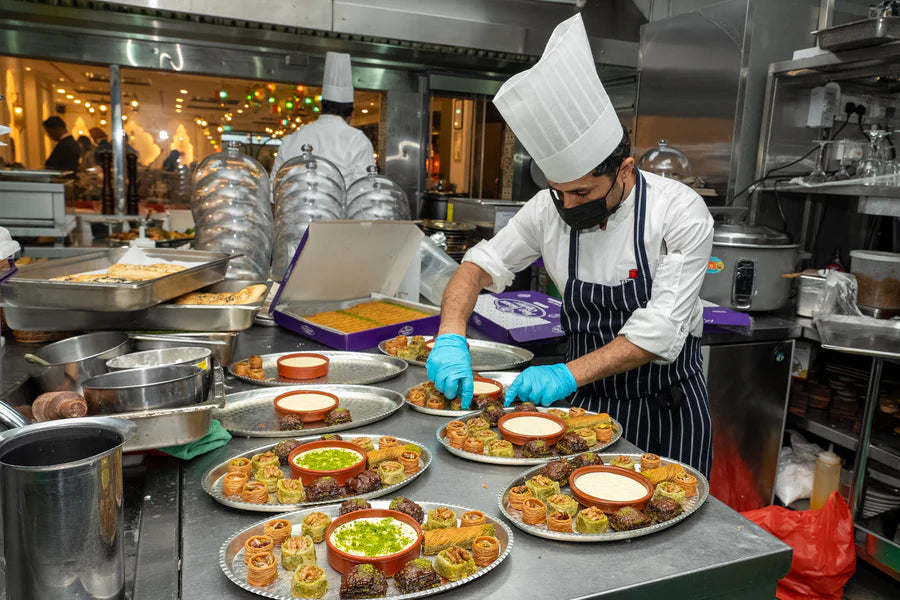
A diamond of baklava reveals neat pastry layers along its cut sides. A roll wraps those layers around the filling. A nest leaves its nuts on display. These differences make a platter attractive, but they also change how each piece breaks apart and how pastry and filling meet in a bite.
The useful distinction is between baklava cut from a layered tray and pastry shaped individually before baking. Once you recognise those two approaches, diamonds, triangles, rolls and rings become much easier to identify. Here is what to look for, and what each shape brings to the plate.
Diamonds: the familiar angled cut
Diamond baklava begins as a flat stack of buttered filo sheets and nut filling. Parallel cuts in one direction, followed by diagonal cuts across them, divide the tray into angled portions. Cutting before baking helps preserve the arrangement of the delicate layers.
The result has a broad middle and two pointed ends. Viewed from the side, each piece shows the relationship between pastry and filling particularly clearly. That visible cross-section is part of the diamond’s appeal: you can appreciate the construction before taking a bite.
For serving, lift a diamond from underneath with a small spatula. Gripping the pointed end can break away the top sheets. Arrange the pieces in alternating directions for a platter that shows off their geometry without needing extra decoration.
Squares and rectangles: straight cuts, tidy portions
Squares and rectangles use a grid instead of diagonal lines. Their straight sides make it easy to divide a rectangular tray into consistent servings and arrange those servings closely together.
The important point is that a different outline does not automatically mean a different recipe. A square and a diamond can contain exactly the same pastry, nuts and syrup. Differences in thickness, filling quantity and baking matter more than whether the corners are right angles.
When comparing pieces, look at height as well as width. A small, tall square may offer a more substantial serving than a broad, shallow rectangle. For a shared dessert platter, reasonably consistent portions help guests choose without accidentally taking much more than they intended.
Triangles: recognise a slice or a folded parcel
Triangular baklava can take more than one form. A layered tray can be divided into triangular portions, leaving exposed cut edges much like diamond baklava. Alternatively, pastry can be folded around filling to create an individual triangle.
Look at the edges to tell them apart. A cut triangle reveals stacked layers; a folded parcel has pastry turning around its sides. This changes where the filling sits and how the piece opens beneath a fork.
Do not assume that every syrup-soaked triangle has an identical nut filling. Some related folded pastries include cream-based fillings. When ordering, the description matters as much as the silhouette, especially if you are expecting the familiar combination of filo and chopped nuts.
Smooth rolls: pastry wrapped around the centre
Finger-shaped or cigar-shaped baklava is formed by rolling pastry around a filling. Depending on the method, the nuts may be concentrated through the middle or distributed between the wrapped sheets.
Instead of the horizontal layers visible in a tray-cut piece, the cut end reveals pastry curving around itself. A narrow roll gives you a different sequence of textures: the outer shell breaks first, followed by the filling and inner pastry.
Rolls are useful when you want slender individual servings, although length alone tells you little about portion size. A thick, tightly filled roll can be quite substantial. Place them side by side with their ends visible so guests can see the construction rather than just a row of golden tops.

Crinkled rolls: folds that change the surface
Crinkled rolls have an accordion-like exterior. One common technique is to wind filo and nuts around a thin rod, gently push the pastry towards the centre, then slide it off. The gathered roll keeps its ridged appearance during baking.
Greek saragli can take this form, although names and methods vary between kitchens. The useful identifying feature is the repeated folds along the roll.
Those folds create a more textured exterior than a smooth cigar. As an eating comparison, pay attention to the contrast between the raised pastry and the syrup-moistened creases. The final balance still depends on baking and syrup application; ridges alone do not guarantee crispness. This shape rewards a closer look because much of its character lies in the surface.
Nests and rings: an open centre for nuts
Nest-shaped pastries curve around an open middle, creating a small space for nuts. The Turkish name bülbül yuvası translates as “nightingale’s nest” and describes this circular form.
Here, the filling becomes part of the presentation. Nuts in the centre contrast with the surrounding pastry ring, making the shape easy to pick out on an assorted platter.
Check the pastry itself, too. Nest-shaped sweets can appear in both sheet-filo and shredded-pastry traditions. Fine, hair-like strands indicate a different construction from folded filo sheets, even when both sweets have syrup and pistachios. Treat “nest” as a description of appearance rather than a guarantee that every version will eat the same way.
Choosing baklava in Singapore: look beyond the outline
Use shape to guide your curiosity, then check the product description. Ask about the filling, portion size and available presentation instead of assuming that a particular outline promises more nuts or less sweetness.
For a local option, Tarboush’s baklava is described as a rich, sweet pastry filled with chopped nuts and pistachios, flavoured with honey. The page also lists Singapore islandwide delivery. It does not offer selectable shape varieties, so confirm the presentation directly if a specific shape matters for your gathering.
When serving an assortment, leave enough space to lift each piece from beneath. Avoid piling delicate nests beneath heavier portions or hiding rolled ends under garnish. The shapes already provide visual variety; a simple arrangement lets that craftsmanship show.
Frequently asked questions
1. Is diamond-shaped baklava a separate flavour?
No. “Diamond” describes the cut. Check the nuts, syrup and flavourings to understand how it will taste.
2. Are baklava rolls always crunchier than squares?
No. Pastry thickness, baking, syrup quantity and freshness all affect crunch. Shape alone cannot reliably predict it.
3. Does a green topping mean the filling is entirely pistachio?
No. Pistachios may be used as garnish over another nut mixture. Read the filling description or ask before ordering.
4. Which baklava shapes suit individual dessert plates?
Any can work. Choose a portion that fits comfortably on the plate and leave room for a fork to separate the layers.
5. Can I order a particular shape from Tarboush?
The online baklava listing does not specify selectable shapes. Confirm your preferred presentation with Tarboush before placing a shape-specific order.